

How to Choose the Right C&I ESS Cabinet: 60kW/110kWh, 100kW/174kWh, or 125kW/261kWh
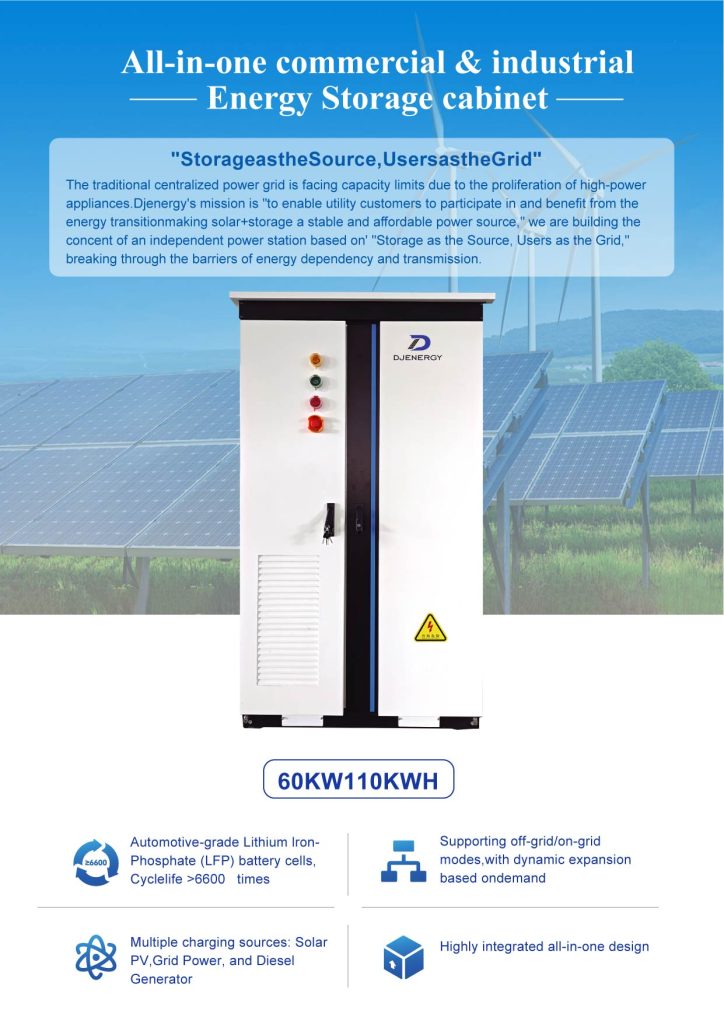
As electricity costs continue to rise and grid stability becomes more challenging in many regions, commercial and industrial users are looking for practical ways to improve energy efficiency, control peak demand, and increase power reliability. For many projects, an all-in-one energy storage cabinet has become one of the most efficient and deployable solutions.
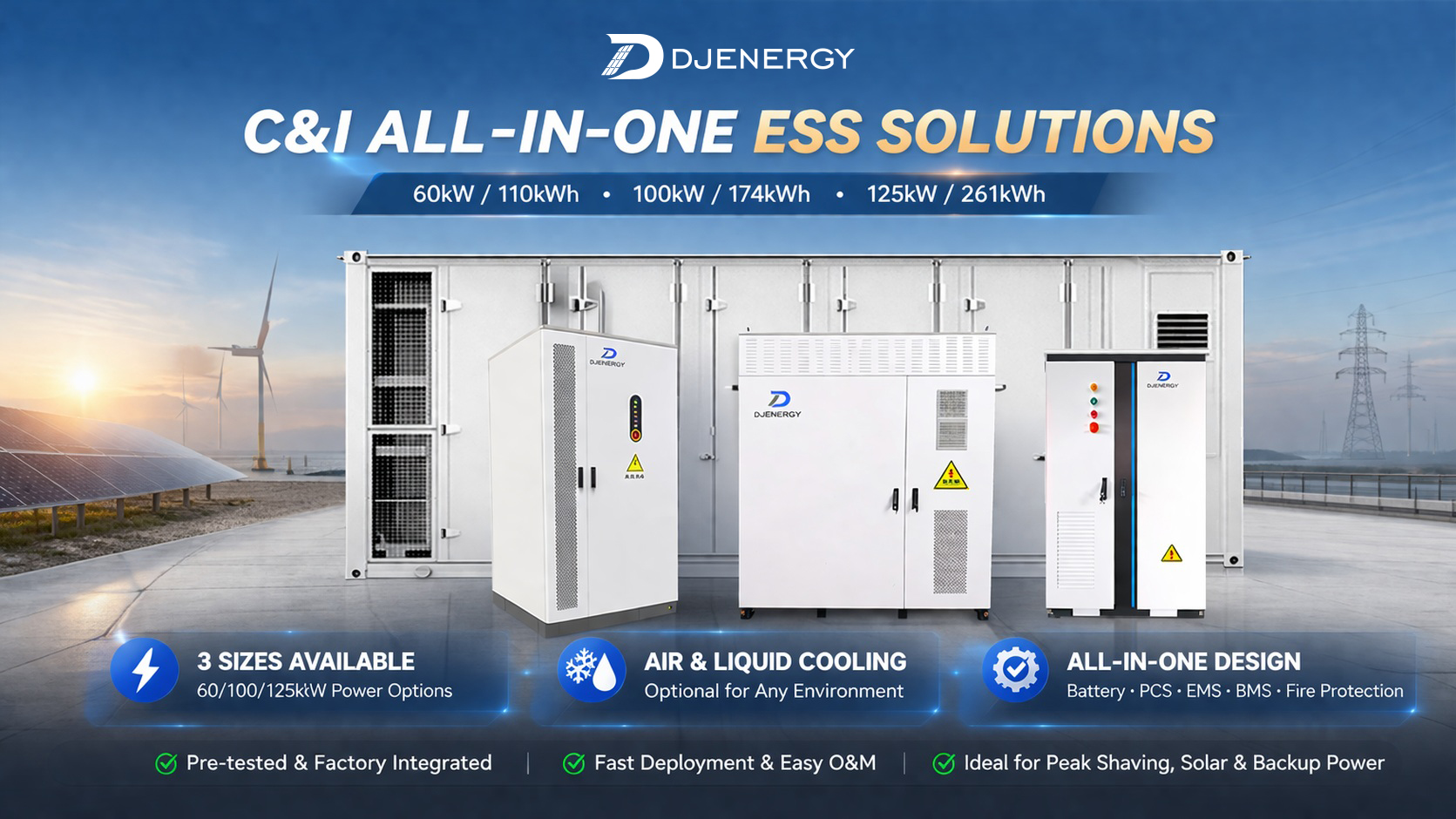
At DJENERGY, we focus on commercial and industrial battery energy storage systems designed for real project needs. Our core all-in-one ESS cabinet range includes 60kW/110kWh, 100kW/174kWh, and 125kW/261kWh, with air cooling and liquid cooling optional based on project requirements, climate conditions, and operating strategy.
This article explains how to choose the right ESS cabinet size, what applications each model fits best, and how cooling options can affect long-term system performance.
Why C&I Users Are Moving to All-in-One ESS Cabinets
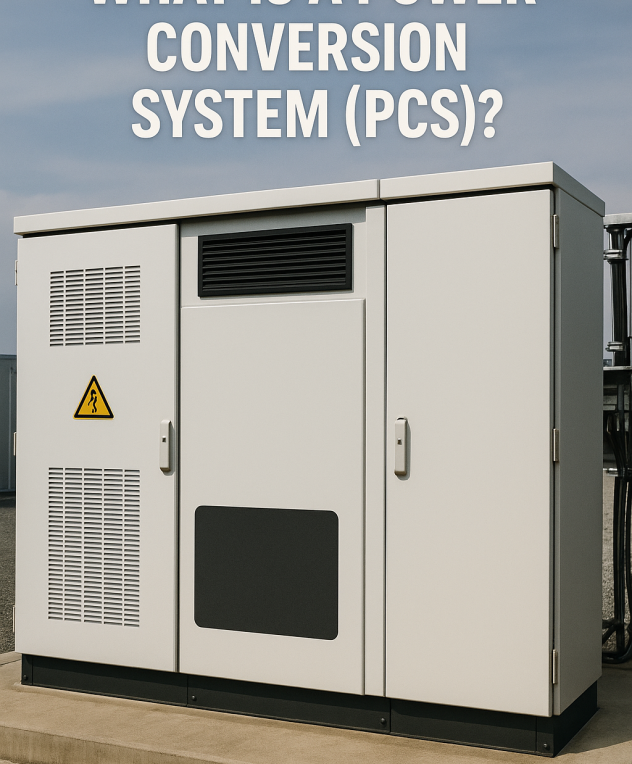
Compared with traditional separated systems, an all-in-one commercial ESS cabinet integrates key components into one compact platform. This usually includes the battery system, PCS, BMS, EMS logic, protection system, and communication interface in a coordinated design.
For project owners, this means several practical advantages:
- Faster installation and commissioning
- Cleaner system integration on site
- Reduced engineering complexity
- Easier expansion for future capacity growth
- Better suitability for peak shaving, load shifting, backup support, and solar integration
For industrial parks, factories, commercial buildings, farms, hotels, and energy service companies, an integrated ESS cabinet is often the most efficient way to deploy storage without the complexity of a container-level system.
DJENERGY C&I ESS Cabinet Range
Our current standard all-in-one ESS product lineup includes three practical configurations:
60kW/110kWh ESS Cabinet
This model is suitable for small to medium commercial loads where the user wants to reduce electricity bills, smooth load fluctuations, and improve local energy flexibility.
It is a strong fit for:
- Small factories
- Workshops
- Commercial stores
- Office buildings
- Telecom or distributed backup applications
- Small PV + storage projects
The 60kW/110kWh configuration is often selected when the project requires a balanced entry-level C&I storage solution with manageable footprint and good economic value.
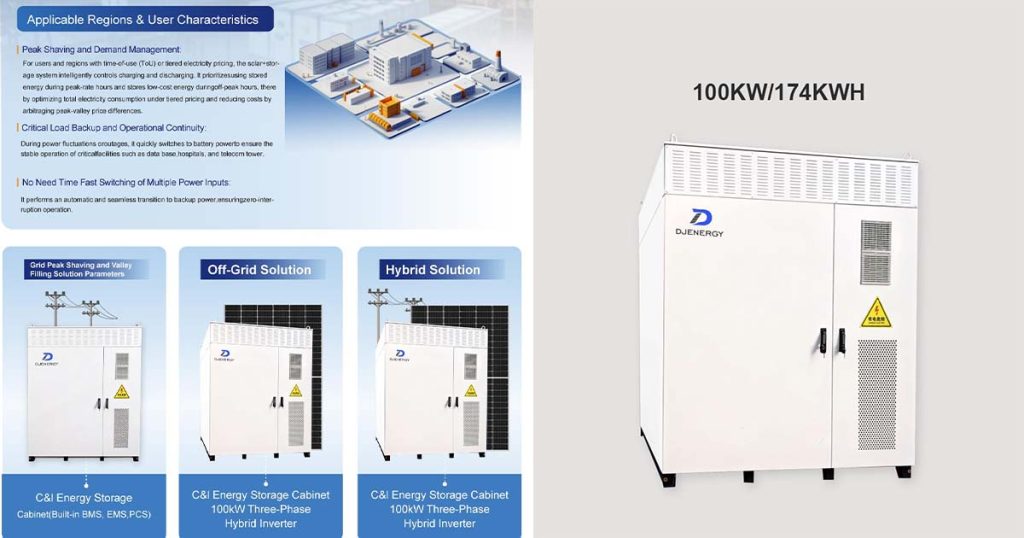
100kW/174kWh ESS Cabinet
This model is a very practical mid-range solution for users with higher daily load variation and more obvious peak demand pressure.
It is suitable for:
- Medium-sized factories
- Warehouses
- Agricultural processing sites
- Commercial complexes
- Hotels and public facilities
- Solar self-consumption optimization projects
The 100kW/174kWh system provides a stronger balance between power output and stored energy, making it a good option for projects that require both daily dispatch and stronger peak demand management.
125kW/261kWh ESS Cabinet
This is the higher-capacity option in the current product range and is designed for more demanding industrial and commercial applications.
It is a strong choice for:
- Larger factories
- Heavy commercial users
- Industrial parks
- Sites with large daytime load swings
- Multi-load energy optimization projects
- Projects planning future parallel expansion
The 125kW/261kWh model is particularly suitable when the customer wants a stronger energy reserve, longer dispatch duration, or more flexibility for site-level power management.
How to Choose the Right ESS Size
Choosing the right ESS cabinet is not only about selecting the biggest model. The correct system depends on the site’s real operating conditions.
There are four key factors to evaluate:
1. Load Profile
The first step is understanding how the site consumes electricity across the day. A project with high short-term peak demand may need more power capacity, while a project with longer evening usage may require more battery capacity.
2. Application Target
Different users have different goals. Some want to reduce demand charges. Some want better solar self-consumption. Others need backup support for critical loads. The application target determines the right ratio between kW and kWh.
3. Grid and Tariff Structure
If the local electricity tariff includes time-of-use pricing or peak demand penalties, ESS can create clear economic value. In such cases, the correct system size should match the charging and discharging windows defined by the utility billing structure.
4. Future Expansion Plan
Many C&I users start with one cabinet and expand later. If the site load is expected to grow, it is wise to choose a solution that supports future parallel operation and system scaling.
Typical Applications of C&I ESS Cabinets
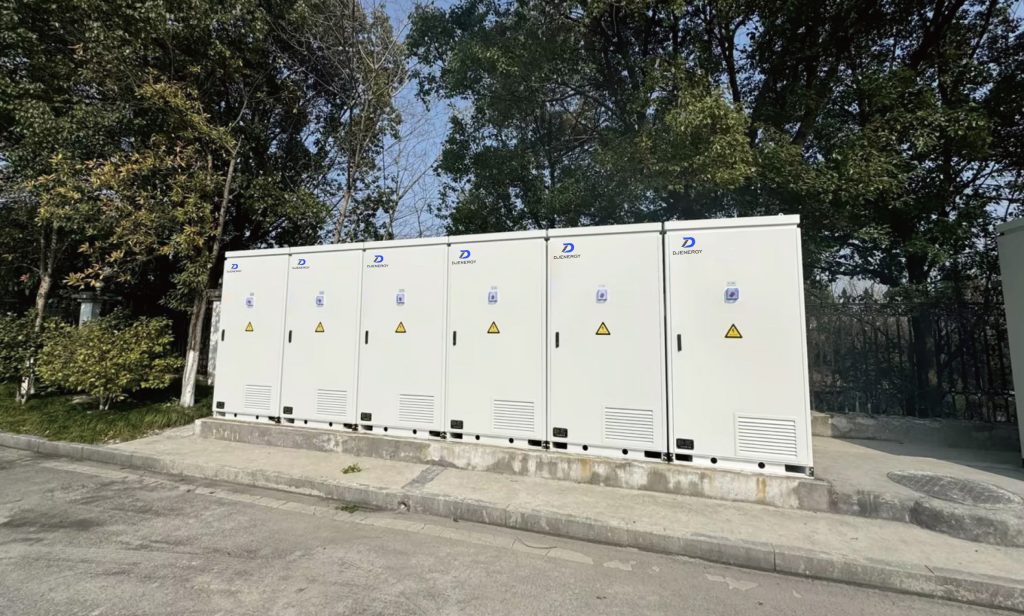
An all-in-one commercial energy storage cabinet can support a wide range of applications. The most common use cases include:
Peak Shaving
The ESS discharges during the site’s peak demand period to reduce grid power draw. This helps lower peak demand charges and smooths power fluctuations.
Time-of-Use Optimization
The system charges when electricity is cheaper and discharges when electricity is more expensive. This improves energy cost efficiency and shortens return cycles in many markets.
Solar Self-Consumption
For sites with rooftop or ground-mounted PV, the ESS stores excess solar generation and uses it later when solar output decreases. This improves solar utilization and reduces power export dependency.
Backup Power Support
In areas with unstable grids, the ESS can support critical loads and improve operational continuity. This is especially valuable for production sites, service facilities, and commercial buildings where power interruptions cause direct losses.
Hybrid Energy Systems
For some sites, ESS can be integrated with solar, grid, and diesel generator systems to improve overall energy management and reduce fuel consumption.
Air Cooling or Liquid Cooling: Which One Is Better?
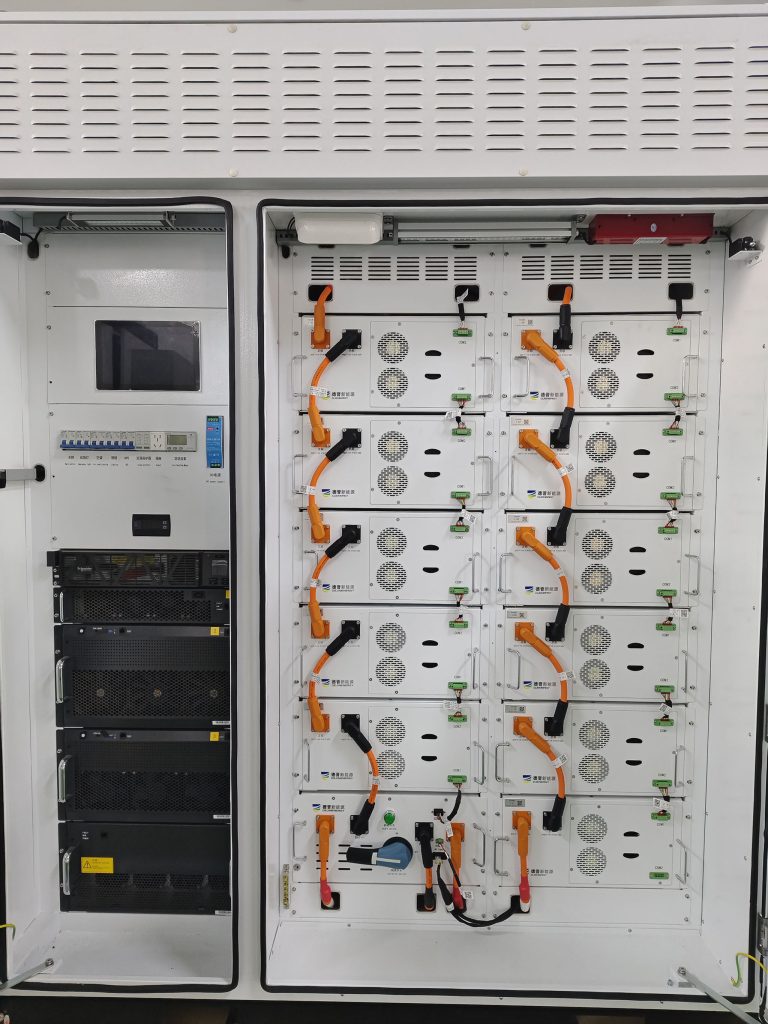
DJENERGY offers air cooling and liquid cooling optional, because different projects have different thermal management needs.
Air Cooling
Air cooling is a practical and cost-effective choice for many standard commercial and industrial projects. It is suitable when:
- The ambient temperature is moderate
- The daily cycling frequency is normal
- The project prioritizes cost control and simpler maintenance
- The site environment is relatively clean and stable
Air-cooled ESS cabinets are widely used in standard C&I scenarios and can provide reliable performance when properly matched to the application.
Liquid Cooling
Liquid cooling is more suitable for projects with higher thermal management requirements. It is often considered when:
- Ambient temperatures are high
- System cycling is more frequent
- The project requires tighter temperature consistency
- Long-term efficiency and thermal stability are priority concerns
- The site is in a demanding climate environment
For hotter regions or more intensive dispatch conditions, liquid cooling can help improve temperature control consistency and support more stable system operation.
In short, the best cooling method depends on your project environment, cycling strategy, maintenance expectations, and budget target.

Why System Integration Matters
In commercial and industrial storage projects, the quality of system integration matters just as much as the battery itself. A well-designed all-in-one ESS cabinet should not only store energy, but also simplify installation, improve communication stability, support flexible control logic, and help operators manage the system more efficiently.
That is why project owners should evaluate:
- System architecture
- Protection design
- EMS strategy
- Communication compatibility
- Site deployment convenience
- Scalability for future growth
A cabinet that looks similar on paper may perform very differently in real project operation depending on how well the full system is engineered.
A Practical Selection Logic
To simplify the decision:
- Choose 60kW/110kWh when the project is smaller, budget-sensitive, or requires a compact entry-level C&I storage solution.
- Choose 100kW/174kWh when the project needs a more balanced solution for daily dispatch, peak shaving, and solar optimization.
- Choose 125kW/261kWh when the site has larger loads, higher energy demand, or stronger expansion expectations.
If the project is in a standard climate and prioritizes cost efficiency, air cooling is usually a practical choice.
If the project operates in a hot environment or under heavier cycling conditions, liquid cooling may be the better long-term option.
Conclusion
Commercial and industrial users no longer need a one-size-fits-all storage solution. The right ESS cabinet should match the site’s load profile, operating objective, project environment, and expansion plan.
DJENERGY’s all-in-one C&I ESS cabinet range — 60kW/110kWh, 100kW/174kWh, and 125kW/261kWh — is designed to give project developers, EPCs, and commercial users flexible options for real-world deployment. With air cooling and liquid cooling optional, these systems can be adapted to different site conditions and business goals.
If you are planning a solar + storage project, a peak shaving solution, or a commercial backup power system, choosing the right ESS configuration at the beginning can significantly improve system value over the long term.
DJENERGY supports customized commercial and industrial ESS solutions based on your load profile, voltage standard, application target, and project environment.