


MPPT vs PWM: Which Solar Charge
What Is a Solar Charge Controller?
A solar charge controller is an essential component in any solar energy system that uses batteries. Its primary role is to regulate the flow of electricity from the solar panels to the battery bank. Without it, batteries can be overcharged, which reduces their lifespan or leads to failure. A charge controller ensures that batteries are charged safely, efficiently, and according to their specifications.
There are two key phases in which a solar charge controller operates:
- Charging Control – It manages the voltage and current going into the batteries to prevent overcharging and deep discharging.
- Load Control (optional) – In some systems, it can also control the power going to connected loads, automatically disconnecting them if battery levels are too low.
Charge controllers also:
- Protect against reverse current flow from the battery to the solar panels at night
- Offer temperature compensation to avoid overcharging in warmer climates
- Provide real-time performance data in modern digital models
The two most widely used types are:
- MPPT (Maximum Power Point Tracking): Efficient and smart, ideal for large systems.
- PWM (Pulse Width Modulation): Simpler and more affordable, best for small-scale setups.
What Is PWM (Pulse Width Modulation)?
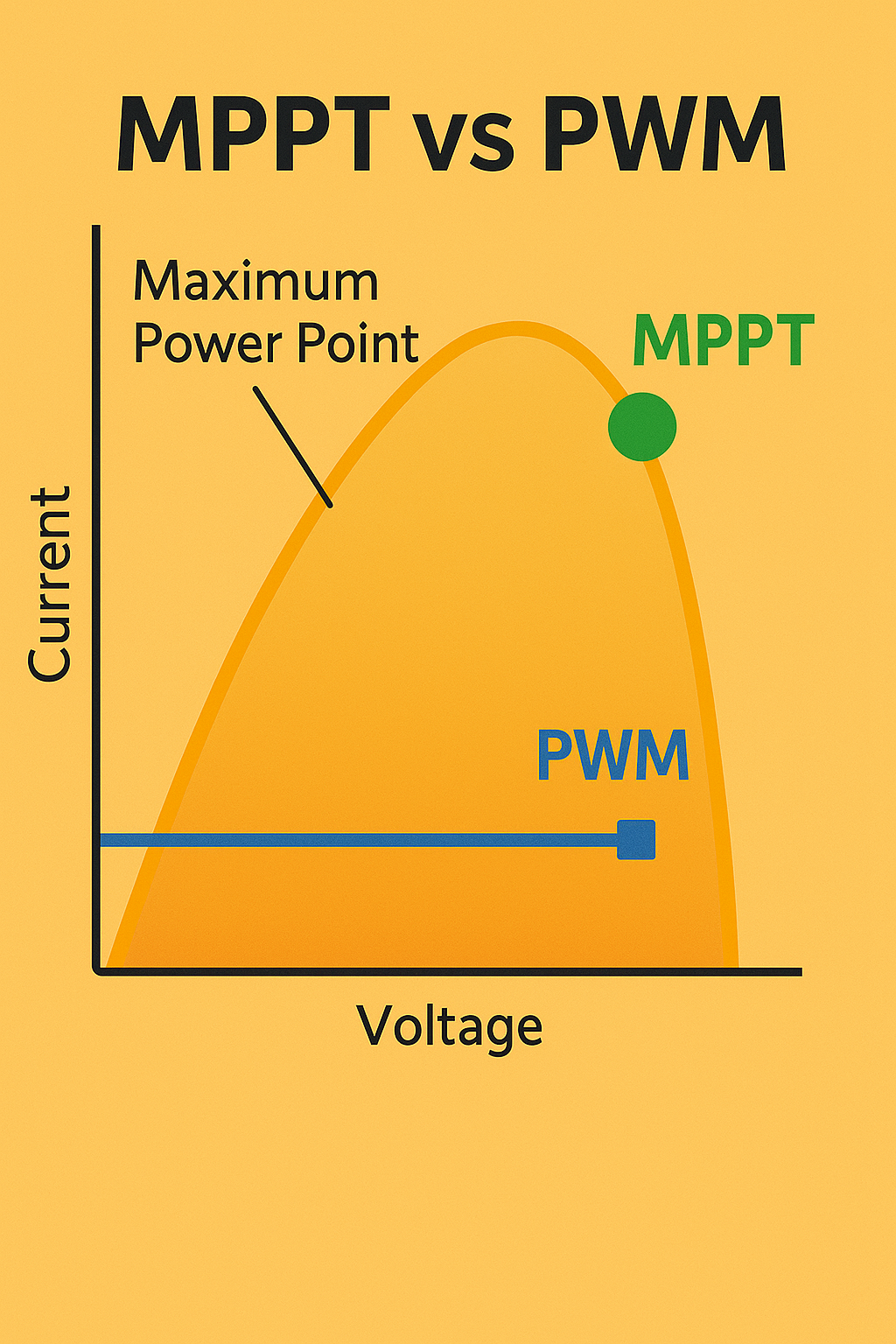
PWM charge controllers use a basic on/off switching method to regulate the charging process. As the battery voltage nears its fully charged level, the PWM controller gradually reduces the current coming from the solar panel by pulsing it—hence the name Pulse Width Modulation. Instead of converting excess voltage into additional current like MPPT controllers, PWM simply matches the panel voltage to the battery voltage and then chops the current accordingly.
This simplicity makes PWM controllers ideal for smaller, budget-conscious systems where cost and reliability outweigh the need for high efficiency. However, in systems where the solar panel voltage is significantly higher than the battery voltage, much of that potential energy is lost as heat rather than converted into usable current.
How PWM Works:
- Connects solar panels directly to the battery
- Pulses voltage in rapid intervals to maintain safe charging
- Best suited when panel voltage is close to battery voltage
Advantages of PWM:
- Economical for small-scale installations
- Durable and long-lasting due to fewer components
- Readily available and easy to install
Limitations of PWM:
- Energy losses in high-voltage systems
- Doesn’t adjust dynamically for environmental changes
- Suboptimal performance in cold or shaded conditions
PWM is best used in simple, low-power applications like RVs, boats, or off-grid sheds where efficiency isn’t a top priority but reliability and affordability are.
PWM charge controllers are a simpler and older technology. They work by slowly reducing the amount of power flowing to the batteries as they get closer to full charge.
What Is MPPT (Maximum Power Point Tracking)?
MPPT charge controllers are advanced, highly efficient solar controllers that optimize the energy harvested from solar panels. Unlike PWM controllers, MPPT systems constantly track the voltage and current from the solar array to find the “maximum power point” — the ideal combination of voltage and current that delivers the most power.
This dynamic tracking enables MPPT controllers to significantly increase energy conversion, especially under varying weather conditions such as cloud cover, shading, or temperature shifts. MPPT controllers can convert excess voltage from high-voltage solar arrays into additional charging current, improving both charging efficiency and overall system performance.
How MPPT Works:
- Monitors voltage and current to identify the optimal power point
- Steps down higher panel voltage to match the battery bank while boosting current
- Adjusts in real time to environmental changes like shading or temperature
Advantages of MPPT:
- Up to 30% higher efficiency than PWM, especially in colder climates
- Supports mixed or high-voltage solar panel configurations (e.g., 24V, 48V)
- Ideal for large or complex solar installations with multiple array inputs
- Increases daily energy harvest, reducing battery charging time
Limitations of MPPT:
- Higher upfront cost due to more advanced circuitry and features
- May require better heat dissipation and ventilation in high-power systems
- Slightly more complex to install and configure, especially for beginners
MPPT controllers are recommended for users looking to maximize energy yield, improve charging precision, and ensure optimal performance across all conditions.
MPPT charge controllers are newer and far more efficient. They continuously monitor the solar panel output and find the maximum power point to convert voltage into current more effectively.
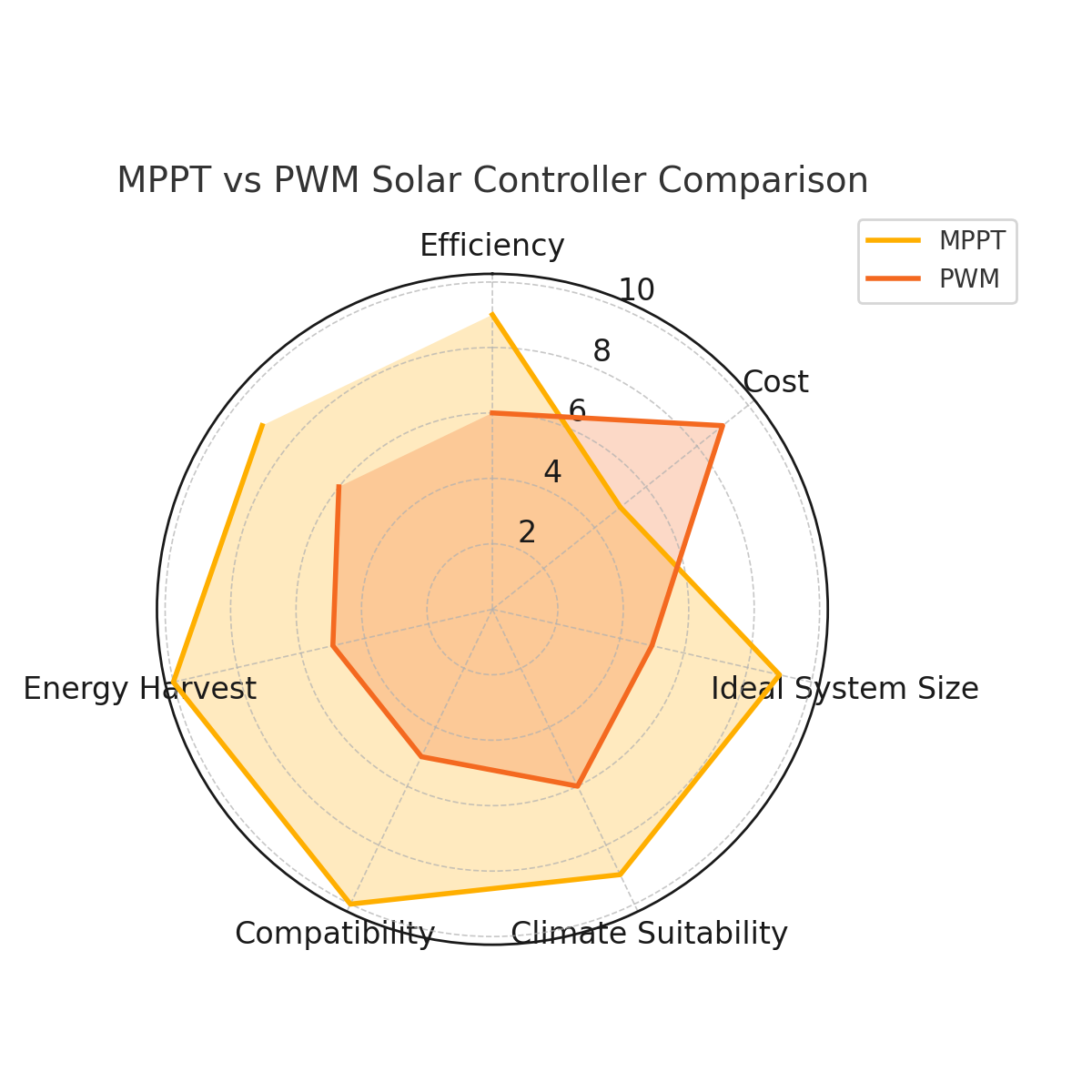
MPPT vs PWM: Solar Controller Comparison
Feature | MPPT Controller | PWM Controller |
Efficiency | 95-99% | 70-85% |
Cost | Higher | Lower |
Ideal System Size | Medium to large solar setups | Small-scale systems (off-grid cabins, RVs) |
Climate Suitability | Excellent in cold, variable sunlight | Less efficient in cold temperatures |
Compatibility | Works with high-voltage arrays | Requires panel voltage near battery voltage |
Energy Harvest | Maximized using voltage-to-current conversion | Fixed voltage, less dynamic control |
Which Solar Charge Controller Should You Choose?
The right solar charge controller depends on your specific system goals, available budget, power requirements, and installation environment. Below is a more detailed breakdown to help guide your choice:
Choose PWM if:
- You are working with a small-scale system under 400 watts.
- Your panel voltage closely matches your battery voltage (12V or 24V setups).
- You’re using the system in stable, warm environments with direct sunlight.
- Cost and simplicity outweigh the need for maximum efficiency.
- Your application is mobile or temporary—like an RV, camper, small boat, or off-grid cabin.
Choose MPPT if:
- You have a medium to large solar installation (400 watts and above).
- Your solar panel array voltage is significantly higher than the battery bank voltage.
- You’re installing in climates with cold temperatures or variable sunlight, where MPPT excels.
- Maximizing energy harvest and system performance is a top priority.
- Your system is stationary, long-term, or part of a high-efficiency solar power setup.
Expert Tip:
If your system size or usage is expected to grow, consider investing in an MPPT controller from the beginning. Its scalability and efficiency will better support future upgrades and changing power needs.
Your choice depends on your specific energy needs, system size, and budget.
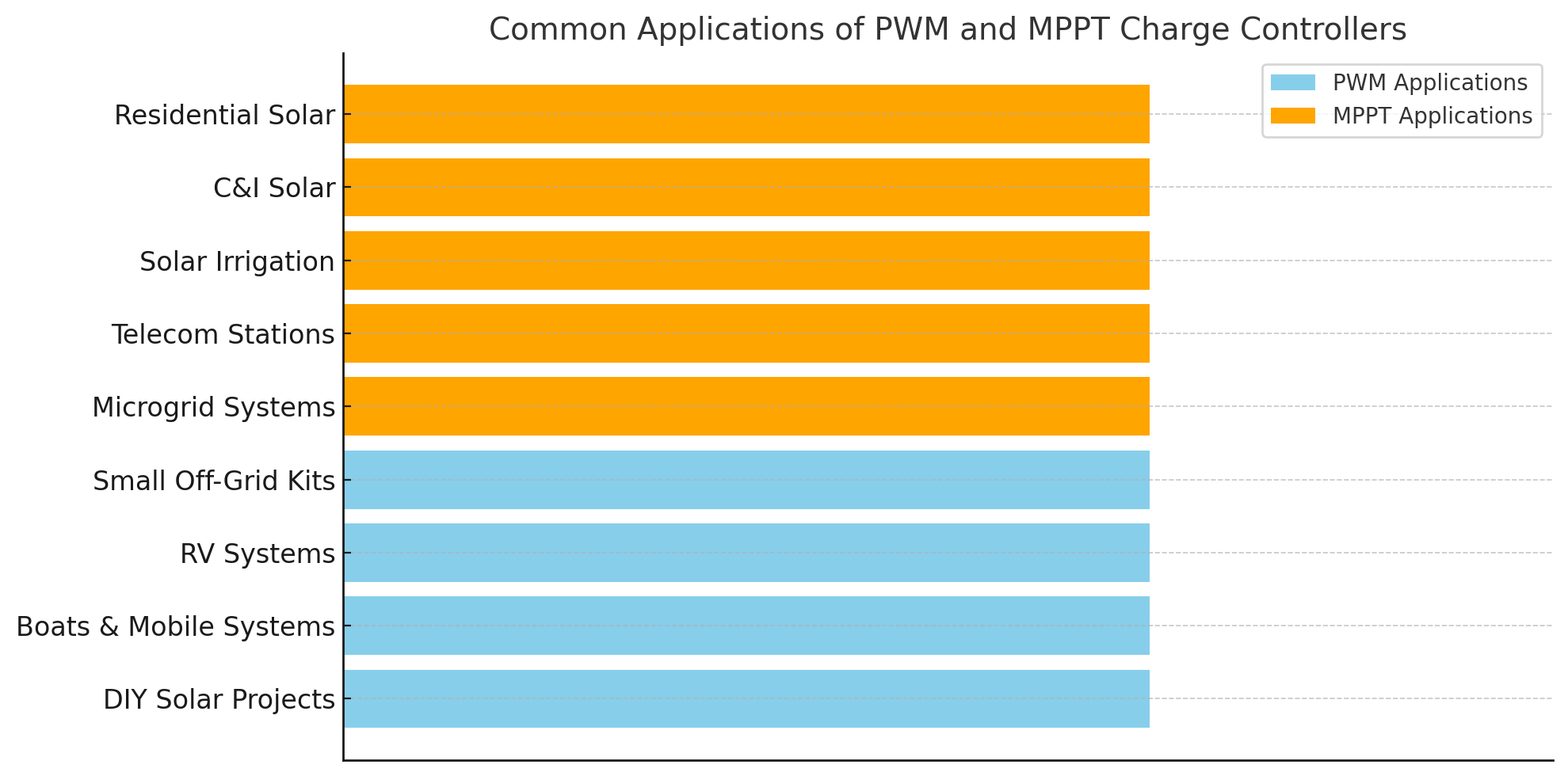
Common Applications of PWM and MPPT Controllers
Understanding where each type of charge controller is most effective can help you build a solar system that performs optimally under your specific conditions. Below is a more detailed overview of the practical use cases for both:
PWM Applications:
- Small Off-Grid Solar Kits: Ideal for powering basic appliances, LED lighting, and USB chargers in remote cabins or emergency kits.
- RV Solar Systems: Affordable and space-efficient, PWM controllers work well when panel and battery voltages are matched.
- Boats and Mobile Systems: Durable and reliable in compact systems where cost and simplicity are priorities.
- DIY Budget-Friendly Projects: Great for hobbyists and educational setups with limited power needs.
MPPT Applications:
- Residential Solar Systems: Helps homeowners maximize solar investment with greater energy harvest and flexibility in panel selection.
- Commercial and Industrial (C&I) Solar: Supports larger loads, improves system efficiency, and reduces operational costs over time.
- Solar Irrigation Systems: Increases reliability for agricultural operations by ensuring full battery capacity even in fluctuating weather.
- Remote Telecom & Surveillance Stations: Critical in off-grid locations where system uptime and efficiency are essential.
- Hybrid and Microgrid Installations: Works with mixed generation sources and variable storage demands to maintain energy stability.
By selecting the appropriate controller based on these application types, users can significantly improve energy efficiency, extend system lifespan, and align with specific performance and budget requirements.
Off-Grid Solar Systems: MPPT vs PWM in Remote Applications
In off-grid solar systems, where energy independence and storage are critical, choosing the right charge controller can make or break your setup. These systems rely on solar panels to generate electricity and batteries to store it, so charging efficiency directly impacts reliability.
- PWM in Off-Grid Systems:
- Best for simple, low-power setups (e.g., cabins, RVs, small backup kits)
- Ideal when panel voltage is close to battery voltage
- More affordable for entry-level and short-term applications
- MPPT in Off-Grid Systems:
- Recommended for systems with high energy demands or larger battery banks
- Adapts to environmental changes (clouds, cold, shade)
- Extracts maximum power, ensuring faster battery charging and better autonomy
For long-term off-grid performance and scalability, MPPT is typically the better choice.
PWM vs MPPT Efficiency Breakdown
Efficiency is one of the most important factors when comparing MPPT vs PWM controllers:
- PWM Efficiency:
- Typically 70–85%
- Limited by panel-battery voltage matching
- Minimal conversion technology
- MPPT Efficiency:
- Ranges from 95–99%
- Dynamically adjusts to extract the most power
- Converts excess voltage into usable current
Over time, this efficiency difference can mean more stored energy, longer battery life, and fewer solar panels needed.
Key Benefits of an MPPT Controller
- Higher Energy Harvest: Captures up to 30% more power than PWM
- Optimized Battery Charging: Smart charging profiles maintain battery health
- Flexibility with Panels: Supports higher voltage PV arrays and longer wire runs
- Scalable: Ideal for systems expected to grow over time
- Best ROI: Delivers superior performance, especially where sunlight is inconsistent
If you’re aiming for maximum power output and long-term reliability—especially in larger or off-grid solar systems—MPPT is usually the superior option.
PWM or MPPT?
When comparing MPPT vs PWM, both have their place in the solar market. PWM is cost-effective and perfect for smaller, simpler systems. MPPT is more efficient and suitable for higher-performance solar arrays.
If you’re investing in a long-term or large-scale setup, the improved energy yield of an MPPT charge controller is often worth the higher cost. For budget-conscious or mobile users, PWM still delivers reliable performance at a lower price point.
Always base your choice on your system’s scale, goals, and environmental conditions.
Related Posts
1 Comment
Comments are closed.
Humanize AI Text
Appreciate the side-by-side comparison—MPPT definitely shines in systems with variable sunlight or higher voltages. But for simpler, low-power setups, PWM still has a role.