


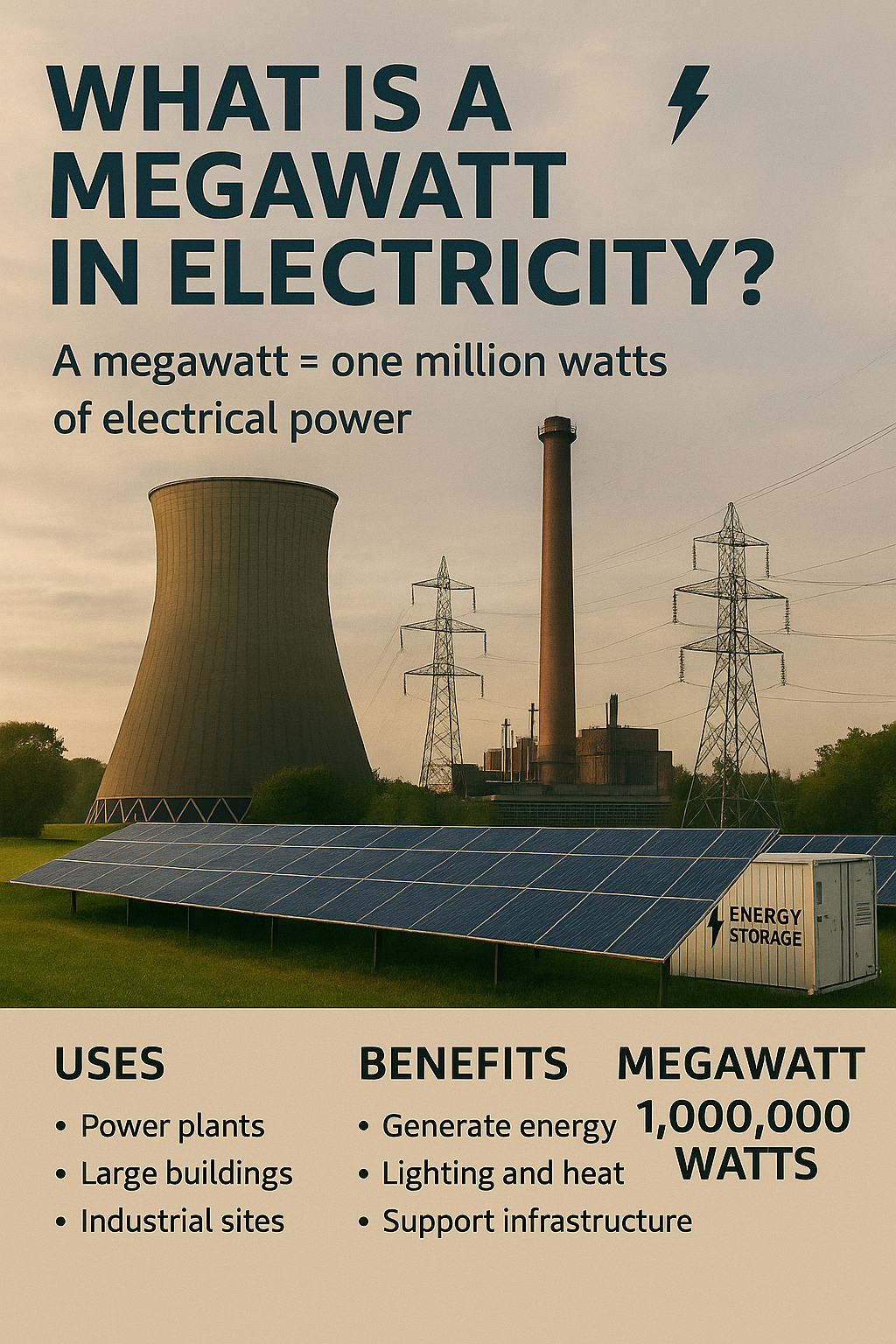
What Is a Megawatt Electricity
In the world of electricity, you’ll often hear terms like kilowatts (kW), megawatts (MW), and gigawatts (GW). These are all units of power used to describe how much electricity is being produced or consumed. But what exactly is a megawatt? And how much electricity does it represent in real-world terms?
This guide will break down the meaning of a megawatt in electricity, how it’s used in power systems, and what it means for households, businesses, and utility-scale energy projects.
“Understanding MW Power in Everyday“
What Is a Megawatt (MW)?
A megawatt (MW) is a unit of power in the International System of Units (SI) equal to one million watts or 1,000 kilowatts (kW). It measures the rate at which energy is generated, transferred, or consumed in an electric system. Megawatts are commonly used to quantify the power output of power plants, large-scale solar and wind farms, and industrial energy usage.
To better understand its size:
- 1 kilowatt (kW) = 1,000 watts
- 1 megawatt (MW) = 1,000 kilowatts = 1,000,000 watts
In residential terms, a single MW can power approximately 750 to 1,000 average U.S. homes simultaneously, depending on their average electricity consumption and the regional climate.
The term is often used when discussing utility-scale power generation, such as a 100 MW wind farm or a 50 MW solar power plant. Megawatt ratings help planners, engineers, and policymakers determine the energy capacity of large systems and assess their impact on regional and national electricity grids.
In summary, a megawatt is a high-capacity measurement essential to understanding modern energy production and infrastructure planning, especially in the context of transitioning to clean energy megawatts and sustainable power solutions.
How Is Megawatt Power Used?
- Power Plants
Power plants are one of the most prominent users of megawatt-level power. Facilities like coal, gas, nuclear, hydro, wind, and solar plants are rated by their power output in megawatts or gigawatts. For instance, a coal power plant might generate 500 MW, supplying electricity to hundreds of thousands of homes. Renewable energy plants such as wind farms or solar fields are also designed with megawatt-scale capacities to integrate into the grid efficiently.
- Commercial and Industrial Facilities
Large businesses and manufacturing facilities often operate on a megawatt scale due to their intensive electricity needs. Data centers, which require constant cooling and power for servers, can consume several MW of power continuously. Similarly, industries such as automotive manufacturing, metal production, or chemical processing may require 1 MW or more just for daily operations.
- Utility-Scale Solar and Wind Projects
Modern renewable energy projects are increasingly built to deliver MW-scale power. A 10 MW solar farm could generate enough electricity to serve a small town or industrial park. These installations feed electricity directly into the grid, and their output is carefully monitored and forecasted to meet energy demands.
- Grid Planning and Load Management
Electric utilities rely on megawatt data for demand forecasting, load balancing, and infrastructure planning. Knowing the MW demand of a neighborhood, city, or industrial region helps grid operators make decisions about power generation, distribution, and emergency capacity. During heatwaves or cold snaps, real-time MW data allows for responsive grid management and blackout prevention.
In all of these areas, understanding and managing power in megawatts is essential to keeping electricity systems reliable, efficient, and prepared for the growing role of clean, renewable energy sources.
Megawatt vs Megawatt-Hour (MW vs MWh)
It’s essential to understand the distinction between power and energy when discussing electricity.
- MW (Megawatt): This measures the rate at which electricity is generated or consumed at a specific moment in time. It’s akin to speed in a car—how fast you’re going.
- MWh (Megawatt hour): This measures the total amount of electricity used or produced over time. Continuing the car analogy, it’s like the total distance you’ve driven.
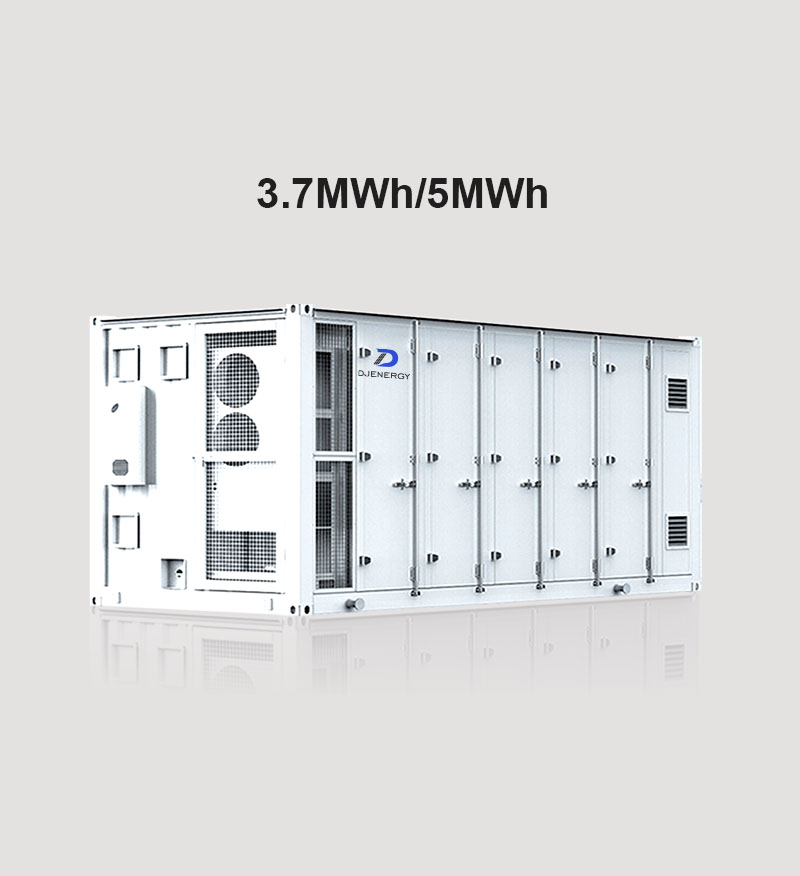
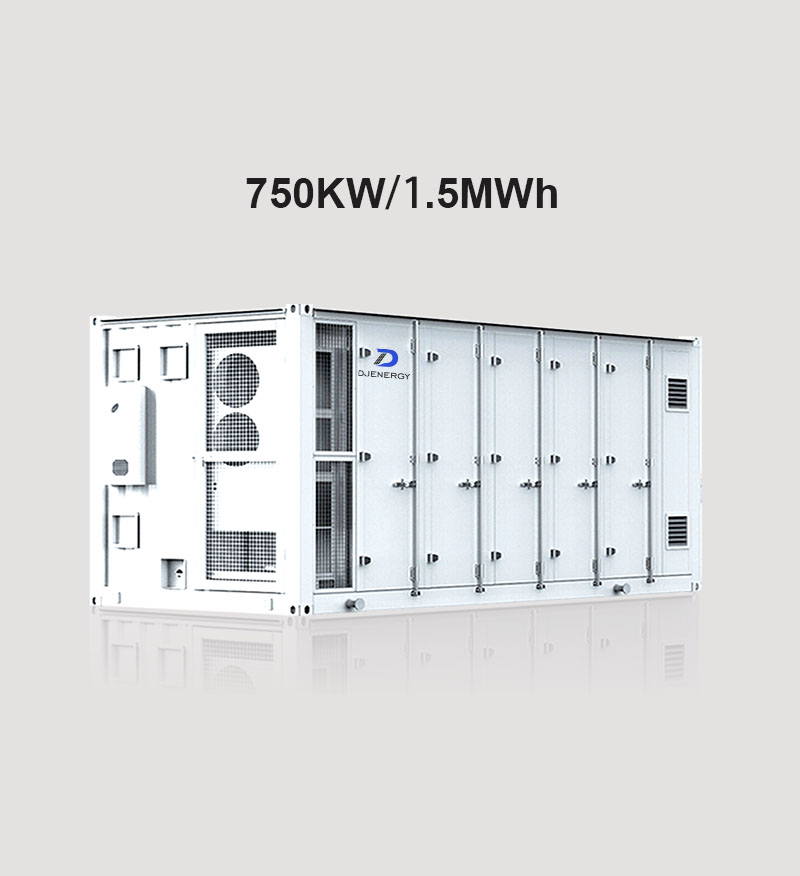
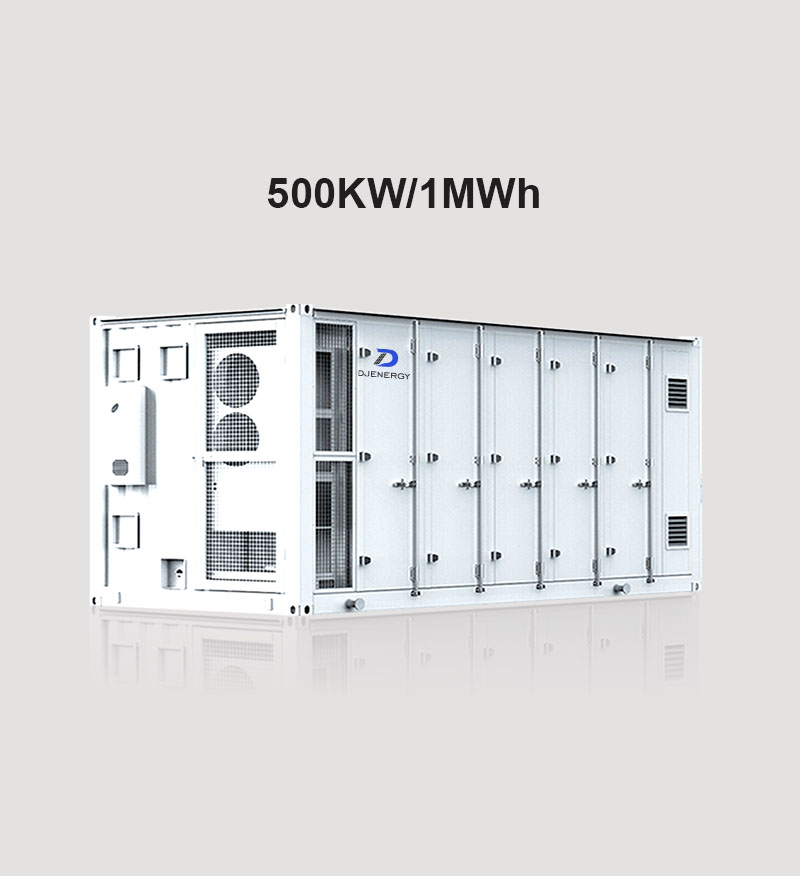
For example, if a 1 MW solar power system operates at full capacity for one hour, it will generate 1 MWh of electricity. If it runs for 4 hours, it will produce 4 MWh. Conversely, a 2 MW plant operating for 30 minutes also produces 1 MWh.
This distinction is critical in billing, energy planning, and performance analysis. Utilities use MWh to determine electricity usage on bills, while MW helps them gauge peak load capacity. For renewable projects, knowing both helps developers understand not only how much energy can be delivered but also when and how quickly it can be dispatched to the grid.
It’s important to distinguish between power and energy.
MW of Electricity: Understanding the Scale
A megawatt MW of electricity is a standard measurement used to describe the capacity of power generation or consumption in medium- to large-scale systems. It’s a critical unit for grid planning, renewable energy development, and infrastructure design.
1. Power Measurement in Large Projects
MW ratings help determine how much power is available or needed for facilities like data centers, factories, and municipal systems. Whether it’s a solar array, wind farm, or gas turbine, MW figures give a snapshot of the plant’s ability to deliver continuous power.
2. Benchmark for Renewable Energy Goals
Governments and energy providers use MW to track progress toward clean energy targets. For example, a state might set a goal to install 5,000 MW of solar or wind capacity within 10 years.
3. Grid and Utility Operations
Utilities manage supply and demand using real-time MW data. This includes dispatching MW-scale generation, managing peak loads, and maintaining system reliability across cities and regions.
4. Planning and Financing Energy Systems
MW figures are central to economic modeling for power plants and renewable projects. Developers use MW capacity to calculate project costs, returns on investment, and environmental benefits like emissions reductions.
Understanding the MW of electricity is foundational for scaling sustainable energy solutions, planning power systems, and meeting global electrification and decarbonization goals.
What Can 1 MW of Power Do?
A 1 megawatt (MW) power capacity provides a clear reference point for understanding energy usage at both residential and industrial scales. Below are specific ways that 1 MW of power is applied across different sectors:
1. Residential Electricity Supply
A 1 MW power source can continuously supply energy to approximately 750 to 1,000 average U.S. households, assuming an average annual consumption of 10,000 to 12,000 kilowatt-hours per home. This makes 1 MW a practical unit for evaluating the energy needs of suburban neighborhoods.
2. Solar Farm Output
A 1 MW solar farm, depending on sunlight exposure and system efficiency, can generate between 1.5 to 1.7 gigawatt-hours (GWh) of electricity per year. It generally requires 4–6 acres of land and includes 3,000 to 4,000 panels.
3. Electric Vehicle (EV) Charging Hubs
EV charging stations operating with a 1 MW power capacity can support up to 300 Level 2 EV chargers per day, or 20–30 DC fast chargers at once, making 1 MW a key unit for planning EV infrastructure.
4. Backup Power for Facilities
Hospitals, data centers, and government agencies commonly install 1 MW backup systems using diesel generators or solar-plus-storage units. This ensures uninterrupted operation during grid failures or natural disasters.
5. Light Industrial Operations
Some small factories, distribution centers, or cold storage facilities operate near the 1 MW threshold. These businesses rely on this power level to run machinery, climate systems, lighting, and IT equipment.
Understanding what 1 MW of power can do provides useful insight into project planning, energy independence, and infrastructure investment.
Real-World Examples of 1 Megawatt
A megawatt (MW) of power can be visualized through real-world scenarios that showcase its practical impact across various sectors. Here are detailed examples:
- Residential Homes: A 1 MW solar installation can power between 750 to 1,000 average U.S. homes simultaneously. This figure depends on regional climate and typical household energy usage, which averages around 10,500 kilowatt-hours (kWh) annually per home.
- Electric Vehicles (EVs): A 1 MW charging facility equipped with multiple Level 2 chargers can service approximately 300 electric vehicles daily. For fast-charging stations (DC fast chargers), the number would be lower, but the charge time is significantly shorter, catering to high-throughput urban areas or highway corridors.
- Hospital Energy Use: A small to mid-sized hospital might consume close to 1 MW continuously, supporting operating rooms, life-support equipment, climate control systems, and diagnostic labs. In energy planning, hospitals often use dedicated 1 MW backup generators or solar-plus-storage systems for resilience.
- Data Centers: Modern data centers vary widely in size, but even a medium-sized facility can draw 1–2 MW to power servers, cooling systems, and redundant systems 24/7. Large hyperscale centers may require tens or hundreds of MW.
- Manufacturing Facilities: Certain types of factories (e.g., metal smelting, plastics, or chemicals) require 1 MW or more for daily operations. Energy-intensive equipment like extrusion machines, furnaces, or high-speed production lines rely on consistent MW-scale power.
Why Megawatt Power Matters
Understanding megawatt power is essential not only for engineers and utility operators, but also for policy makers, businesses, and consumers navigating a rapidly changing energy landscape. The megawatt serves as a foundational unit for decision-making in energy infrastructure, investment, and sustainability strategies.
- Grid Infrastructure
Power grid systems are designed, expanded, and upgraded based on projected megawatt demand. Whether preparing for peak summer usage or planning new substations, grid operators depend on MW-level forecasts to maintain reliability and avoid blackouts. Real-time MW monitoring is used to balance generation and load, dispatch reserve capacity, and support demand response programs.
- Renewable Energy Scaling
As wind and solar farms are added to the grid, each system’s contribution is tracked in MW. National and regional governments set renewable energy targets in megawatts or gigawatts to measure deployment progress. Understanding MW output helps evaluate how much clean energy is offsetting fossil fuels and how close we are to meeting climate goals.
- Energy Investment and Planning
Energy developers, utilities, and financiers use megawatt capacity to evaluate the feasibility and profitability of energy projects. Whether building a 5 MW community solar farm or a 300 MW wind project, MW estimates help assess capital costs, expected generation, ROI, and payback periods. MW benchmarks are also used to qualify for federal and state-level tax incentives.
- Environmental Impact
Transitioning just 1 MW from fossil fuel sources to clean energy (like wind or solar) prevents approximately 1,100 to 1,500 metric tons of carbon dioxide emissions annually. Multiplied across thousands of MWs, this has a profound impact on air quality, public health, and global carbon footprints. Megawatt transitions are also used to model the environmental benefits of electrifying vehicles, buildings, and industries.
By understanding megawatt power and its implications, stakeholders at all levels can make more informed, impactful decisions that support energy efficiency, decarbonization, and economic growth.
How to Calculate Megawatt Usage
Calculating electricity usage in megawatts helps quantify large-scale power demands in industries, infrastructure, and large commercial applications. It involves converting the power consumption of multiple devices or systems from kilowatts (kW) or watts (W) into megawatts (MW).
Step-by-Step Conversion:
- Identify Equipment Ratings: Determine the power rating (in kW or W) of each device or system involved.
- Sum the Total Load: Add all the individual power ratings together to get the total system demand.
- Convert to Megawatts: Divide the total kilowatts by 1,000, or divide watts by 1,000,000 to express the total in megawatts.
Formula:
From kilowatts to megawatts:
MW = kW / 1,000
From watts to megawatts:
MW = W / 1,000,000
From megawatts to kilowatts:
kW = MW × 1,000
From megawatts to watts:
W = MW × 1,000,000
Example 1: Commercial HVAC System
- 50 air conditioning units rated at 12 kW each
- Total power = 50 × 12 = 600 kW
- Converted to MW: 600 ÷ 1,000 = 0.6 MW
Example 2: Industrial Machinery
- 3 industrial compressors at 200 kW each, and 2 furnaces at 300 kW each
- Total power = (3 × 200) + (2 × 300) = 600 + 600 = 1,200 kW
- Converted to MW: 1,200 ÷ 1,000 = 1.2 MW
Accurately calculating MW usage is essential for designing energy infrastructure, planning grid connections, and managing load capacities, especially for renewable energy integration or utility-scale project development.
To estimate electricity use in MW, convert from kilowatts or watts:
- Add up the kW rating of each device or system
- Divide the total by 1,000 to convert to MW
Example:
- 100 air conditioners at 10 kW each = 1,000 kW = 1 MW of demand.
Electricity Unit Conversion: Understanding Scale Across Units
To make sense of how electrical power and energy scale, it’s important to understand how different units relate to each other. Here’s a quick breakdown of the most common electricity unit conversion and how they convert:
1. Power (Rate of Energy Use or Generation)
- 1 megawatt (MW) = 1,000 kilowatts (kW)
- 1 kilowatt (kW) = 1,000 watts (W)
- 1 megawatt (MW) = 1,000,000 watts (W)
- 1 gigawatt (GW) = 1,000 megawatts (MW)
These are used to describe the rate at which electricity is consumed or generated at any given moment.
2. Energy (Amount of Power Used Over Time)
- 1 megawatt-hour (MWh) = 1 MW sustained for 1 hour
- 1 kilowatt-hour (kWh) = 1 kW sustained for 1 hour
- 1 gigawatt-hour (GWh) = 1 GW sustained for 1 hour = 1,000 MWh
3. Common Conversions
Power:
MW = kW ÷ 1,000
kW = W ÷ 1,000
MW = W ÷ 1,000,000
Energy:
MWh = kWh ÷ 1,000
GWh = MWh ÷ 1,000
4. Application Examples
- A 1,000 W microwave = 1 kW
- A 5 kW solar system on a house = 0.005 MW
- A 500 MW gas plant operating for 2 hours = 1,000 MWh of energy produced
These conversions are essential for understanding how small devices relate to large-scale infrastructure, and how power is tracked across time and systems in both residential and utility-scale energy planning.
Megawatt Power in Different Energy Sources
Energy Source | MW Output (Typical) | Homes Powered (Est.) |
Residential Solar | 5 kW per home | ~1 home |
Wind Turbine (onshore) | 2–3 MW | 500–800 homes |
Utility Solar Farm | 10 MW | 2,000+ homes |
Natural Gas Plant | 500 MW+ | ~400,000 homes |
Coal Plant | 600–1,000 MW | 500,000–900,000 homes |
Nuclear Plant | 1,000+ MW | 1 million+ homes |
How Megawatts Relate to Other Units of Power
Unit | Equivalent to 1 MW |
Watts (W) | 1,000,000 W |
Kilowatts (kW) | 1,000 kW |
Gigawatts (GW) | 0.001 GW |
Horsepower | ~1,341 HP |
The Role of Megawatts in the Clean Energy Transition
Measuring in megawatts is especially important in large-scale renewable energy projects. Every added MW of wind or solar helps reduce reliance on fossil fuels. Countries set renewable energy targets in terms of megawatts or gigawatts of clean power.
The global push for net-zero emissions includes scaling up MW-level projects in solar, wind, hydro, and battery storage. The more we understand what a megawatt is, the better we can track clean energy progress.
Why Knowing About Megawatt Electricity Matters
Understanding the megawatt as a unit of electricity helps everyone—from consumers to engineers—grasp the scale of energy production, usage, and potential savings. As the world builds out more MW-scale solar, wind, and battery projects, the role of megawatts becomes increasingly central to how we plan, power, and protect our energy future.
Whether you’re investing in clean energy, studying power systems, or just curious about how much electricity a city needs—knowing what a megawatt represents is a smart starting point.
How is a megawatt different from a megawatt-hour?
A megawatt (MW) is a unit of power indicating the rate of electricity usage or production at a given moment. A megawatt-hour (MWh), on the other hand, measures the total amount of energy used or produced over an hour. For example, running a 1 MW system for two hours produces 2 MWh of energy.
How long does it take for a 1 MW solar system to pay for itself?
Most 1 MW solar projects have a payback period of 5 to 8 years, depending on installation costs, sunlight availability, energy rates, and available incentives such as tax credits. Over a 25-year lifespan, these systems can generate substantial returns and long-term savings.
Can residential buildings consume a megawatt of power?
A typical single-family home uses far less than 1 MW, but large residential complexes, especially those with high-end amenities, elevators, or electric vehicle chargers, may have peak demands that approach or exceed 1 MW.
How do electric utilities use megawatt data?
Utilities use megawatt-level monitoring for load forecasting, demand response, and grid stability. Real-time data helps them match supply with consumption, prevent blackouts, and optimize generation from renewable and conventional sources.
Why is megawatt capacity important in clean energy planning?
Megawatt capacity determines how much renewable energy is available to replace fossil fuels. Governments and companies set energy goals in MW or GW to track renewable deployment, improve energy security, and cut emissions.
Related Posts
1 Comment
Comments are closed.
Text to Coloring
Understanding the scale of a megawatt really puts renewable energy discussions into perspective. It’s interesting how we toss around these terms without always grasping the real-world implications.