What is the C rate in BESS

What is the C rate in BESS?

Understanding the C Rate in BESS: Key Qualities and Real-World Applications

Introduction: Why C Rate Matters in Battery Energy Storage Systems (BESS)

As the world embraces green energy projects and renewable power solutions, Battery Energy Storage Systems (BESS) have become critical to grid modernization. Whether you’re designing a small microgrid or a utility scale energy farm, understanding the C rate is essential for optimizing performance, longevity, and cost-effectiveness.

In this guide, we’ll explore what the C rate means in BESS, how it impacts system design, how to apply concepts like C rate discharge, and real-world examples involving MW power projects.

C Rate in BESS: Key Qualities

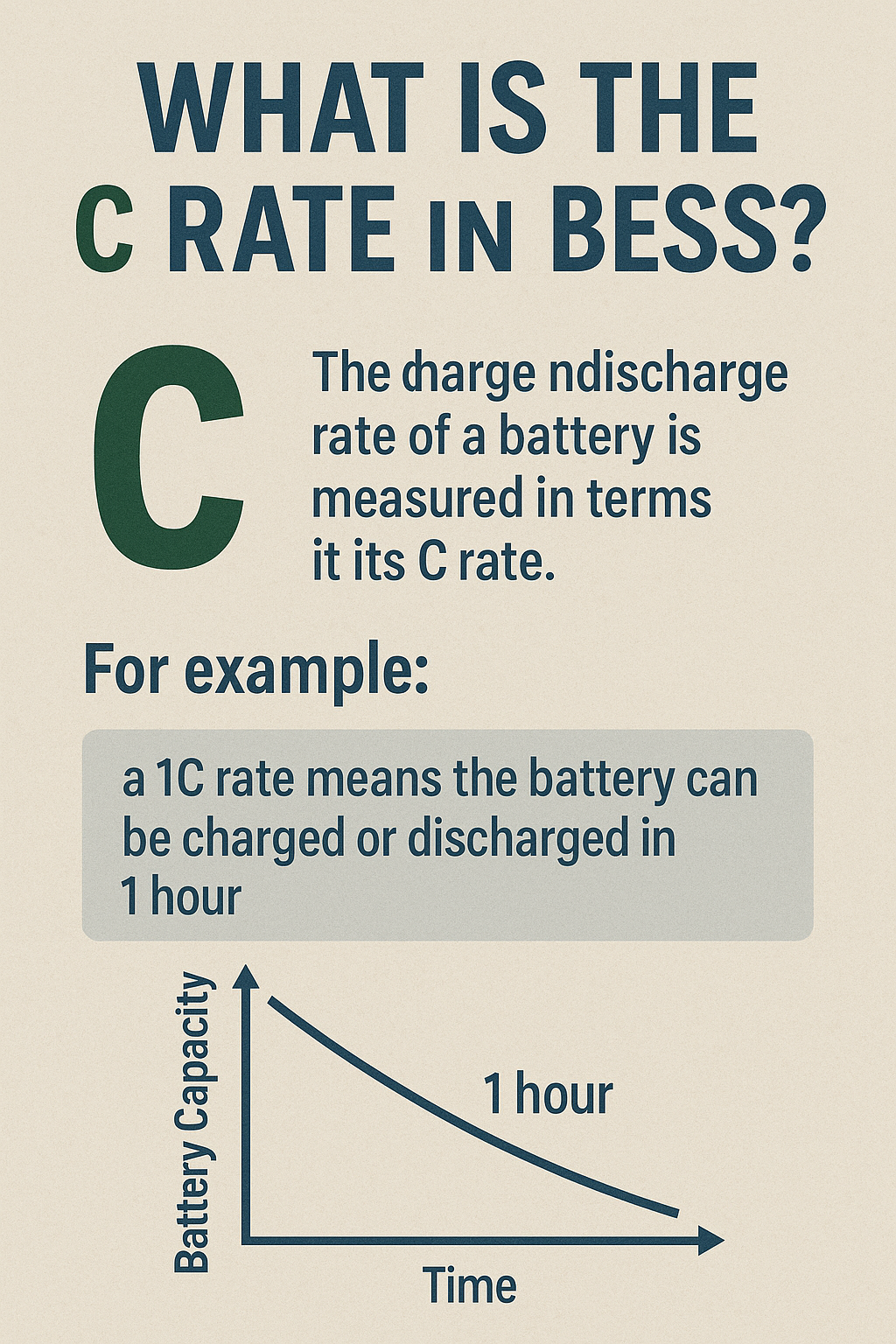
The C rate (or battery C rating) is a key performance metric that measures how quickly a battery can be charged or discharged relative to its maximum energy capacity. It indicates the rate at which a battery can safely deliver or absorb current without risking damage or excessive degradation. A higher C rate means the battery can handle faster charging and discharging, essential for applications that require rapid energy delivery, such as frequency regulation and emergency backup services. Conversely, a lower C rate suggests slower, steadier energy release, which benefits battery longevity and is ideal for long-duration storage in renewable power projects. Understanding the C rate helps in optimizing battery design, ensuring operational efficiency, and aligning system capabilities with the demands of various green energy projects and utility scale applications.

  • 1C rate: Discharging the full capacity in 1 hour.
  • 0.5C rate: Discharging the full capacity in 2 hours.
  • 2C rate: Discharging the full capacity in 30 minutes.

For example, a 100 kWh battery at 1C can deliver 100 kW continuously for 1 hour, while at 0.5C, it would deliver 50 kW for 2 hours.

Understanding C Rate Discharge

C rate discharge defines the rate at which energy is drawn from a battery relative to its total capacity. It essentially measures how fast the battery can be discharged safely and effectively. This parameter is vital for BESS sizing because it directly impacts the system’s ability to meet power demands, maintain operational efficiency, and avoid premature battery degradation. For instance, if a system needs high bursts of energy over short periods, a higher C rate is necessary. Conversely, applications requiring steady, prolonged energy delivery favor lower C rates. Properly aligning the c rating with the application ensures optimal performance, longevity, and cost-effectiveness in both utility scale and renewable power projects.

  • A higher C rate provides more instantaneous power but increases battery wear.
  • A lower C rate promotes longevity but limits peak power availability.

In renewable power systems, matching the c rating to the expected load profile ensures the system can handle both steady demand and sudden spikes.

Key Qualities of C Rate in BESS Design

The C rate significantly impacts the performance, efficiency, and longevity of Battery Energy Storage Systems (BESS). Understanding these key qualities helps optimize system design for different applications, from renewable power smoothing to high-demand utility scale operations.

  1. Impact on System Performance

Higher C ratings allow batteries to respond more quickly to changes in grid demand. This rapid response is crucial for services like frequency regulation, voltage support, and emergency backup in large MW power grids. The ability to deliver instantaneous energy can prevent blackouts and maintain grid stability.

  1. Influence on Battery Life

The rate at which a battery is charged or discharged affects its overall health and longevity. Lower c rate discharge settings, such as 0.5C, result in less internal heat generation and chemical stress, extending the operational life of the battery system. For long-term renewable storage or daily cycling applications, lower C rates maximize return on investment.

  1. Safety and Thermal Management

Fast charging and discharging at high C rates increase thermal loads, requiring sophisticated cooling systems. Efficient thermal management is vital to prevent overheating, which can lead to accelerated degradation or safety hazards. Proper control ensures that even high voltage batteries operating at 1C or higher stay within safe operational limits.

  1. Cost Optimization

Choosing the correct battery C rating ensures that the BESS is neither overbuilt (leading to unnecessary costs) nor underbuilt (resulting in performance shortfalls). An optimal design balances upfront investment with operational needs, lifecycle costs, and revenue opportunities from energy markets.

Overall, aligning the C rate with the specific needs of a project is key to achieving performance goals, minimizing risks, and maximizing economic returns in any green energy project or grid power storage deployment.

Common C Rates in Utility-Scale and Renewable Projects

In the world of large-scale energy storage and renewable power development, understanding the typical C rates applied to different projects is crucial. The choice of C rate affects everything from the number of batteries needed to the system’s ability to respond to changing grid conditions.

C Rate 0.5C

  • Discharge Time: 2 hours
  • Ideal for: Applications where energy needs to be supplied steadily over longer periods, such as solar energy time-shifting.
  • Use Case: Solar farms supporting evening peak loads or agricultural green energy projects where energy demand follows a predictable daily pattern.
  • Advantages: Lower heat generation, extended battery life, reduced stress on battery materials, and better long-term cost savings.
  • Challenges: Slower response to sudden demand surges; may require more careful load forecasting and management.

C Rate 1C

  • Discharge Time: 1 hour
  • Ideal for: Scenarios requiring fast energy delivery, such as grid frequency regulation, emergency backup, and ancillary services.
  • Use Case: High-demand utility scale storage installations participating in fast-responding energy markets where quick dispatch is critical.
  • Advantages: High responsiveness to sudden load changes, greater flexibility in energy trading opportunities, and critical support for grid stability.
  • Challenges: Higher thermal management requirements, increased wear and tear on battery components, and more intensive maintenance schedules.

By carefully choosing between 0.5C and 1C, project developers can align system capabilities with specific operational goals, balancing performance needs against battery longevity and operational costs. Proper C rate selection is foundational to successful grid power storage projects and overall renewable integration strategies.

C Rate vs MW Power: How It Connects

In designing BESS for MW power applications:

  • A 10 MW / 10 MWh BESS at 1C can output 10 MW for 1 hour.
  • A 10 MW / 20 MWh BESS at 0.5C can output 10 MW for 2 hours.

Choosing between 0.5C and 1C depends on the project’s goals — fast response or sustained delivery.

Selecting the Right C Rating for Your Project

  • Renewable Energy Projects: A lower C rate discharge (like 0.5C) is ideal for smoothing variable generation.
  • Grid Services: A higher battery C rating (1C or higher) is preferred for fast demand-response.
  • Backup Systems: Systems prioritizing reliability over speed typically favor a lower c rating.

Challenges of Managing C Rates in BESS

Managing C rates in Battery Energy Storage Systems (BESS) presents several technical and operational challenges that must be carefully addressed to ensure optimal system performance, longevity, and economic viability.

Battery Degradation

Operating at high C rates increases mechanical and chemical stress on the battery’s internal structure. Fast charge and discharge cycles accelerate electrode wear, electrolyte decomposition, and other forms of degradation. Over time, this leads to reduced battery capacity, diminished efficiency, and the need for more frequent replacements, raising long-term operating costs.

Thermal Management Needs

High C rate discharge operations generate significant heat, which can jeopardize battery integrity and safety if not properly controlled. Effective thermal management systems—including active cooling technologies and advanced thermal interfaces—are critical for preventing overheating, ensuring stable operation, and minimizing risks such as thermal runaway, particularly in large utility scale installations.

Grid Compatibility

Matching the battery’s C rate capabilities with specific grid service requirements is essential for maximizing system value. Misalignment can result in penalties from grid operators, inefficient use of the storage asset, or even failure to meet regulatory standards. Detailed load forecasting, dynamic control systems, and grid-responsive design strategies are necessary to ensure that MW power delivery is aligned with the demands of green energy projects and renewable power markets.

Successfully managing these challenges requires a deep understanding of both battery science and grid operations, along with careful system design, proactive maintenance, and the use of sophisticated control algorithms to dynamically adjust operating parameters based on real-time conditions.

Real-World Examples

Solar Plus Storage (0.5C Design)

A 50 MW solar plant pairs with a 25 MW / 50 MWh battery at 0.5C to provide evening peak energy.

Wind Farm Frequency Support (1C Design)

A 30 MW wind farm uses a 30 MW / 30 MWh battery system at 1C for real-time frequency control and renewable integration.

EV Solar Charging Stations (0.5C to 1C)

Solar-powered EV hubs often use batteries between 0.5C and 1C depending on charging speed requirements.

Why Understanding C Rate Is Critical

The C rate is a fundamental metric in Battery Energy Storage Systems, influencing everything from system performance and longevity to project economics. Whether designing a solar charging station, a green energy project, or a massive utility scale BESS, mastering c rate discharge concepts ensures smarter, more sustainable solutions.

Choosing between 0.5C and 1C can dramatically shape outcomes — from how long you can supply MW power, to the lifespan of your batteries in renewable power systems. With the right knowledge, your next energy project will be built for efficiency, reliability, and the future.


C Rate

About C Rate in BESS

Understanding the capabilities and applications of a 1 megawatt (MW) energy system is crucial for communities, businesses, and developers planning energy solutions. Whether it's powering a rural village, setting up a solar farm, or creating EV charging stations, 1MW of power can have a significant impact. Below, we answer some of the most common questions about the costs, uses, maintenance, and performance of 1MW energy systems to help you better plan your projects and investments.

What happens if a battery is discharged at a higher C rate than recommended?

Excessive discharge rates cause batteries to overheat, experience faster aging, and suffer from reduced overall life expectancy. When a battery is pushed beyond its recommended battery C rating, it can develop internal damage such as electrode degradation, electrolyte breakdown, and even potential safety risks like thermal runaway. Always adhere to manufacturer guidelines and incorporate thermal management systems to safely operate at the designated C rate.

Why is 0.5C preferred for renewable energy projects?

A 0.5C rate is ideal for renewable energy projects because it offers a balanced approach to energy delivery and battery health. It supports long-duration, steady power output needed for smoothing solar and wind variability, reduces thermal stress, and significantly extends battery lifespan. Lower C rates help lower operational costs over time, making them particularly suitable for green infrastructure where sustainability is a priority.

Is 1C discharge safe for utility-scale storage?

Yes, 1C discharge is generally safe for utility scale BESS installations when designed with proper thermal controls and monitoring systems. Many MW power grid services like frequency regulation, voltage support, and spinning reserves require rapid energy discharge capabilities, which 1C-rated systems can deliver reliably if thermal stability is maintained and batteries are appropriately cycled.

How does C rating affect MW power output?

The C rating dictates how quickly a battery can discharge its stored energy. A higher C rate allows a system to deliver a higher amount of MW power over a short period, essential for rapid-response applications. Conversely, a lower C rate supports extended energy release over longer periods, ideal for load shifting, renewable energy storage, and backup power solutions.

Can the C rate be adjusted during operation?

Advanced BESS systems today can dynamically manage and optimize the battery C rating during real-time operation. Using smart energy management systems, operators can adjust C rates based on external conditions such as grid demand, weather forecasts, and market pricing opportunities. This flexibility helps maximize efficiency, improve battery lifespan, and adapt to variable energy service needs.

1 Comment

  • The explanation of C rate as it relates to both small-scale and utility-scale BESS really helped clarify its practical implications. It’s easy to overlook how significantly it impacts both battery life and discharge efficiency, especially when scaling systems for different energy needs.

Comments are closed.