

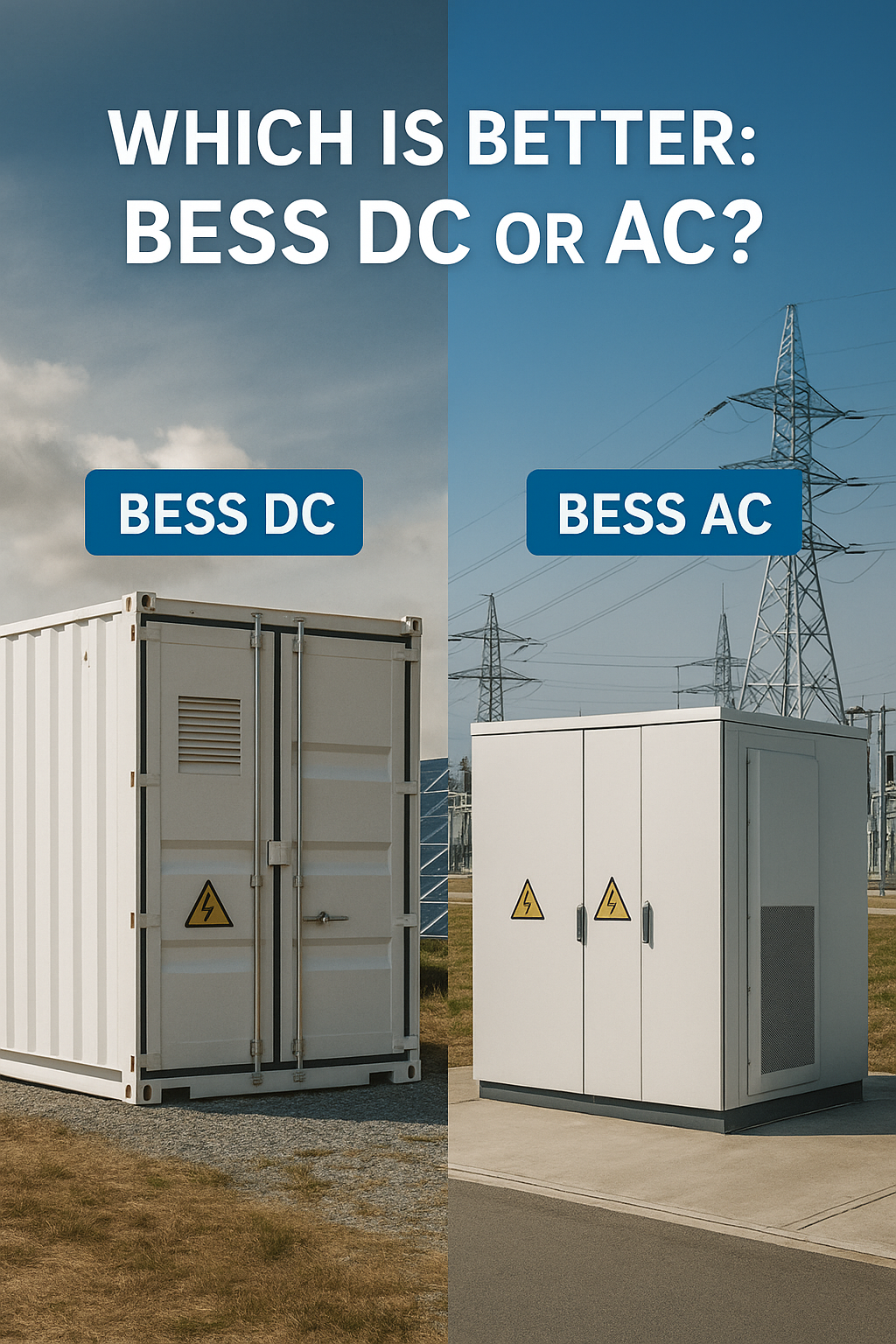
Which Is Better: BESS DC or AC
Understanding BESS and Power Conversion
As energy storage technology grows more vital to the renewable energy transition, Battery Energy Storage Systems (BESS) have become a cornerstone of modern grid infrastructure. Whether you’re designing a commercial microgrid, integrating storage with solar, or supporting frequency regulation, choosing between DC-coupled BESS and AC-coupled BESS is a critical decision.
In this blog, we break down the key differences, use cases, and advantages of both systems to help you decide: Which is better—BESS DC or AC?
“A Clear Guide for Energy Storage Decisions“
A Battery Energy Storage System (BESS) stores electricity in chemical batteries and discharges it when needed. It can help balance supply and demand, integrate renewable energy like solar and wind, and provide backup power during grid failures.
Modern BESS installations are often based on lithium-ion technology, including LiFePO4 (lithium iron phosphate) for its high thermal stability and long life cycle.
BESS can be:
- DC coupled, where the battery connects directly to the DC side of a solar PV or power source.
- AC coupled, where the battery system connects to the AC electrical grid via inverters.
DC Coupled BESS Explained
A DC coupled battery energy storage system connects directly to the DC bus of a power source, such as a solar PV array, before any AC conversion occurs. This architecture enables more streamlined power flow and minimizes energy loss by reducing the number of conversions.
How It Works:
- Solar panels generate direct current (DC) electricity.
- The DC power is directly routed into the BESS for storage.
- When energy is needed, the stored DC electricity is converted once into alternating current (AC) using an inverter to power the grid or connected loads.
Advantages of DC Coupled Systems:
- Higher Round-Trip Efficiency: With fewer energy conversion stages (only one from DC to AC), DC-coupled systems reduce losses and maximize stored energy use.
- Direct Solar Charging: Enables solar energy to charge batteries without immediate inversion, ideal for net-zero and off-grid configurations.
- Reduced Equipment Needs: Requires fewer inverters and separate interconnection components, which can translate to lower capital expenditures.
- Optimized for Integrated Solar + Storage: Especially effective when building new PV projects where the BESS is part of the original system design.
- Improved System Coordination: Centralized DC bus architecture can simplify control algorithms and reduce response latency in energy dispatch.
Ideal Use Cases:
- New solar + storage installations
- Large-scale renewable energy projects
- Microgrids focused on solar time-shifting
- Energy-as-a-Service providers optimizing system design for high efficiency and cost-effectiveness
A DC coupled battery energy storage system connects directly to the DC bus of a power source, like a solar PV array, before the inverter.
AC Coupled BESS Explained
An AC coupled Battery Energy Storage System (BESS) interfaces with the electrical grid or local power network through inverters. It operates independently of solar generation systems and is especially well-suited for enhancing existing infrastructure.
How It Works:
- Solar panels produce DC electricity, which is immediately converted into AC by a dedicated inverter.
- The AC electricity powers loads or is routed to an AC-coupled battery system.
- The battery charges by converting AC back to DC.
- When needed, a second inverter converts the battery’s stored DC electricity back into usable AC.
Advantages of AC Coupled Systems:
- Flexible Retrofitting: Perfect for upgrading existing solar systems with energy storage without reconfiguring the original DC-side wiring.
- Bidirectional Power Flow: Allows batteries to charge from either the grid or solar PV, making the system more adaptable for time-of-use or demand charge strategies.
- Grid Services Compatibility: Supports functions such as frequency regulation, spinning reserves, and voltage support, which are increasingly in demand from utilities.
- Scalability: System elements (PV, storage, load) can be sized, installed, and expanded independently, providing design and operational flexibility.
- Improved Reliability: Each inverter operates independently, so one system fault doesn’t necessarily compromise the entire setup.
Ideal Use Cases:
- Retrofitting commercial or residential solar systems with storage
- Commercial energy users seeking demand charge reduction
- Participation in utility grid service programs
- Backup power for critical facilities in grid-tied environments
An AC-coupled architecture offers operational autonomy and is often favored in markets where regulatory incentives reward dispatchable grid services and flexible load shaping.
An AC coupled BESS connects to the electrical grid or local power system via inverters. It is independent of the energy source and typically paired with an AC panel or grid-connected inverter.
DC vs AC-Coupled BESS: Head-to-Head Comparison
Feature | DC-Coupled BESS | AC-Coupled BESS | ||
Conversion Steps | One (DC → AC) | Two (DC → AC → DC → AC) | ||
Efficiency | Higher efficiency due to reduced conversions | Slightly lower due to multiple conversion stages | ||
Integration with PV | Direct connection; ideal for solar + storage installations | Indirect via grid-tied inverter; suitable for existing PV systems | ||
Cost | Lower hardware and installation costs for new projects | Higher for retrofits due to added inverter and rewiring needs | ||
System Independence | Requires PV system; less flexible for non-solar integration | Fully independent; can charge from grid or solar | ||
Grid Services Compatibility | Limited; less suited for real-time grid interaction | High; ideal for frequency regulation, peak shaving, and demand response | ||
Scalability | Best scaled as part of integrated solar + storage system | Modular; easy to scale each component independently | ||
Reliability | Centralized architecture; efficiency-optimized but less fault-tolerant | Decentralized; independent components enhance system robustness | ||
Monitoring and Control | Shared control systems for PV and BESS; streamlined but may be less flexible | Separate monitoring; allows granular control and advanced analytics | ||
Best for | New solar + storage deployments, utility-scale PV integration | Retrofits, commercial grid services, backup for mission-critical infrastructure | New installations | Existing PV, grid support |
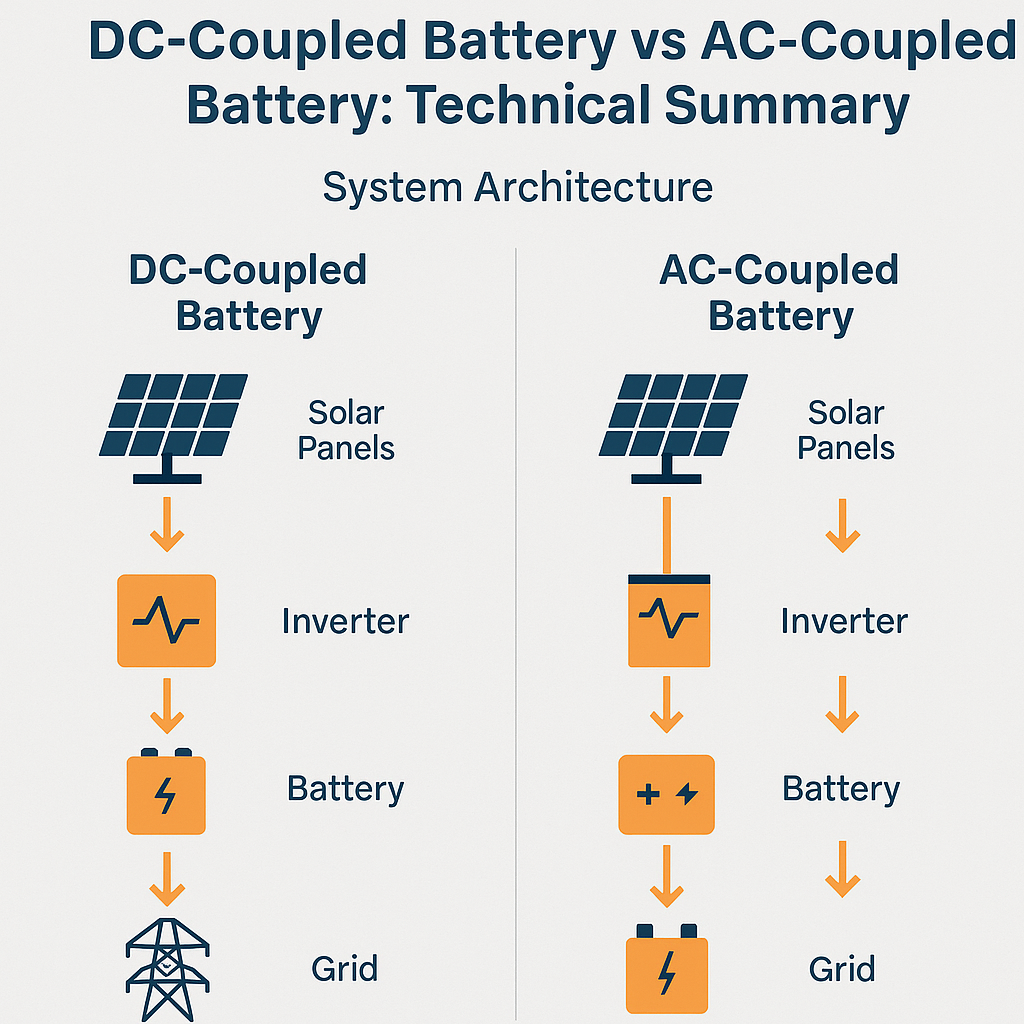
DC Coupled Battery vs AC Coupled Battery: Technical Summary
Understanding the technical nuances between DC-coupled batteries and AC-coupled batteries is crucial for effective energy storage system design. Here’s a detailed comparison:
DC Coupled Battery:
- Power Flow: Direct connection to the DC bus allows solar panels to charge batteries without intermediate AC conversion.
- System Efficiency: Reduced power conversion improves round-trip efficiency.
- Inverter Dependency: Requires a hybrid inverter capable of managing both PV and battery outputs.
- Charging Source: Typically limited to on-site DC sources like PV arrays.
- Simplicity: Streamlined configuration makes it ideal for integrated solar + storage applications.
- Monitoring: Centralized monitoring may reduce complexity but limit flexibility.
AC Coupled Battery:
- Power Flow: Requires bidirectional inverters to convert energy between AC and DC for both charging and discharging.
- System Efficiency: Slightly lower due to multiple conversion stages.
- Inverter Independence: Uses dedicated inverters for PV and battery, enhancing system modularity.
- Charging Source: Can be charged from either the grid or solar, offering greater operational flexibility.
- Versatility: Suitable for retrofits and backup systems where grid interaction is needed.
- Monitoring: Separate monitoring systems offer granular data and better fault isolation.
This comparison reinforces that the right choice between DC- and AC-coupled batteries depends not only on technical specifications but also on application-specific priorities like energy independence, grid participation, and long-term scalability.
Which Is Better: BESS DC or AC?
To help you decide at a glance, here’s a quick decision chart based on your system type and storage goals:
Quick Decision Guide
Your Situation | Recommended BESS Type |
Installing a new solar + storage system | DC-Coupled |
Retrofitting an existing solar array | AC-Coupled |
Need to charge storage from both grid and solar | AC-Coupled |
Optimizing round-trip efficiency for solar generation | DC-Coupled |
Participating in grid services (e.g. demand response) | AC-Coupled |
Reducing capital costs with fewer components | DC-Coupled |
Requiring modular and scalable infrastructure | AC-Coupled |
Building a standalone microgrid | DC-Coupled |
Use this guide as a starting point for system planning. For the best results, consult with an energy engineer or installer to evaluate site-specific needs.
DC Coupled BESS Is Better When:
Choosing between DC coupled and AC coupled Battery Energy Storage Systems (BESS) comes down to specific project goals, infrastructure, and budget. Both systems provide valuable benefits, but their ideal use cases differ based on whether you’re designing a new installation or upgrading an existing one.
DC Coupled BESS Is Better When:
- You are building a new solar + storage system where integration efficiency is key.
- Maximizing round-trip energy efficiency is a priority.
- You want to reduce capital costs by minimizing inverters and wiring complexity.
- Time-shifting solar energy production is essential (charging batteries directly from PV during the day and discharging later).
AC-Coupled BESS Is Better When:
- You are retrofitting an existing solar PV installation.
- You need operational flexibility to charge from both solar and the grid.
- Your project requires participation in grid services like frequency regulation or demand response.
- Independent scalability, modularity, and ease of maintenance are important.
Decision-Making Tip:
Consider the age of your solar system, available space, grid connectivity, and whether you’ll need storage to operate independently or as part of a larger, integrated solution. For projects prioritizing simplicity, cost-effectiveness, and solar efficiency, DC-coupled makes sense. For projects needing resilience, multi-source charging, and advanced grid features, AC-coupled may be the better route.
Ultimately, both systems have a place in the evolving energy landscape. The “better” system is the one best aligned with your operational, financial, and technical goals.
Choose Based on Your Goals
There’s no one-size-fits-all answer. When evaluating AC or DC BESS, consider your existing infrastructure, energy goals, and available incentives. Work with experienced solar and storage professionals to model performance and ROI for each option.
Making the right choice between AC and DC battery storage ensures long-term efficiency, resilience, and financial returns for your solar or hybrid energy project.
Related Posts
1 Comment
Comments are closed.


AI Quiz Generator
Great breakdown on the differences between DC and AC BESS systems. I’ve found that DC-coupled systems tend to be more efficient with solar setups, but AC systems offer more flexibility for retrofits—curious to hear how others weigh that trade-off.